
More than half of marketers say insights fail to consistently drive campaign changes.
AI has the capacity to collapse the long reporting times which are the root cause of this paralysis. Yet despite widespread experimentation, AI adoption has hit a wall.
The findings in this report point to a lack of trust in AI. Marketers are significantly less likely to trust AI-generated insights than AI-free ones, despite reporting that they are significantly more reliable than manual reporting.
Their biggest problem with AI analytics is that it lacks context, especially around data governance and business goals. Without this, AI tools produce confidently wrong answers, even if the data sets are high quality.
This report argues that the missing piece to carry that context is a marketing knowledge layer: a governed layer of business and data context that allows AI to operate from the same shared understanding as the people using it.
53%
of marketers say data insights fail to consistently drive campaign action
91%
of marketers take at least a few days to act on clearly underperforming campaigns
83%
of marketers have had key decisions delayed by disagreements about that data in the last quarter alone
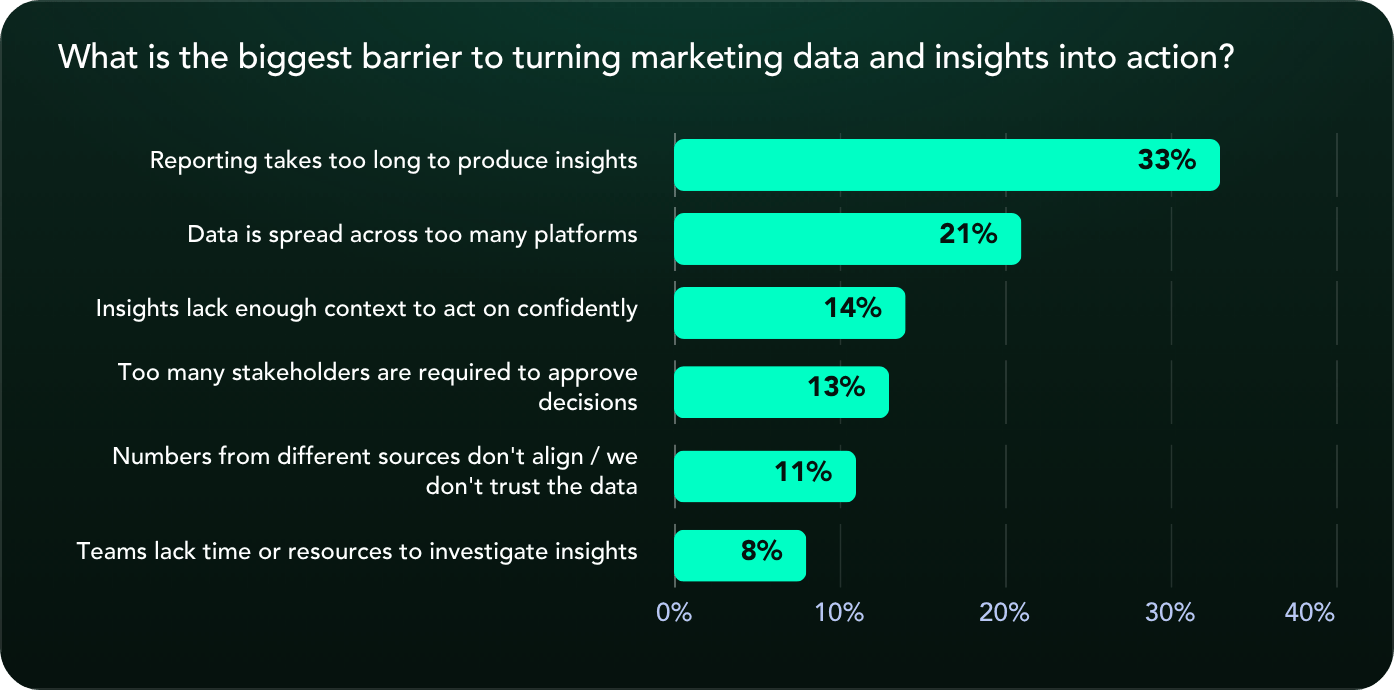
33%
say the biggest barrier to acting on data is that reporting takes too long
92%
AI experimentation and adoption are high, averaging 92% across use cases
2×
Marketers are nearly twice as likely to trust AI-free insights, despite reporting that AI-assisted insights have significantly fewer errors
The two biggest issues marketers face when using AI tools for data analysis are:
39%
eg, tools don’t understand campaign objectives, KPIs, and decision context
24%
eg, AI tools don’t understand or abide by governance and quality rules
The infrastructure surrounding data pipelines has become incredibly complex and sophisticated in order to take advantage of all this data. However, it seems that most marketers are still stuck.
Despite best efforts and a wave of new AI tools accompanied by new bold claims, less than half of marketers say their data-based insights often directly lead to campaign changes or optimizations. Only 5% manage to act on insights derived from their data consistently.
This paralysis is a major problem facing the industry, made all the more pertinent by a deluge of low quality AI-generated insights from tools unleashed upon the market without vetting to ensure proper marketing knowledge and data context.

Customer behavior is complex and changeable, and acting on trends is often time-sensitive. Delays can be critical, leading to missed opportunities or wasted budget.
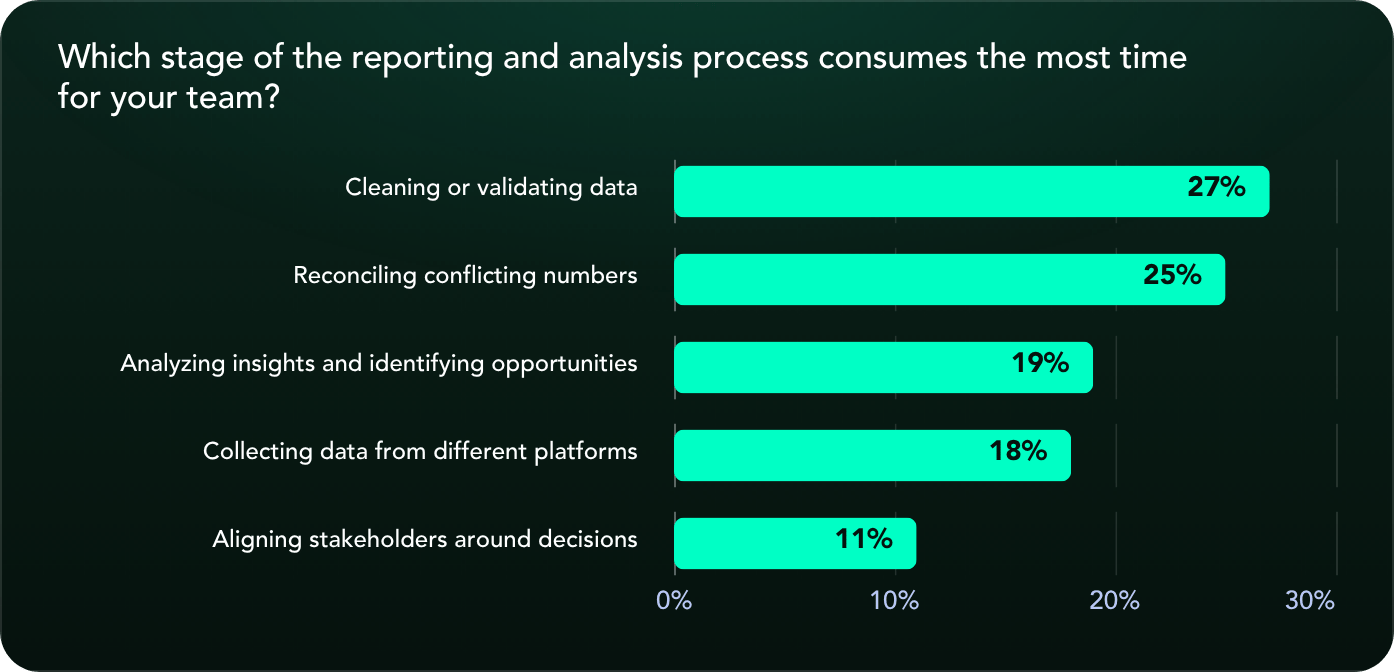
Marketers report that the most time-intensive reporting task is cleaning and validating data (27%), followed by reconciling conflicting numbers (25%). Teams are spending a considerable amount of their time on these low-value tasks rather than using data to shape campaigns and guide strategy. These are the parts of the job where human judgment creates the most value, and yet only 19% say they spend most of their time analyzing data insights and identifying opportunities.
AI has the potential to reduce these reporting delays by lowering the technical barriers (SQL, Python) that keep professionals siloed, and allowing teams to focus on work that actually moves marketing outcomes forward. The caveat, of course, is that automating reporting without first establishing a governed data foundation doesn’t solve the problem, and AI tools operating without the necessary context encoded will simply produce wrong answers faster.
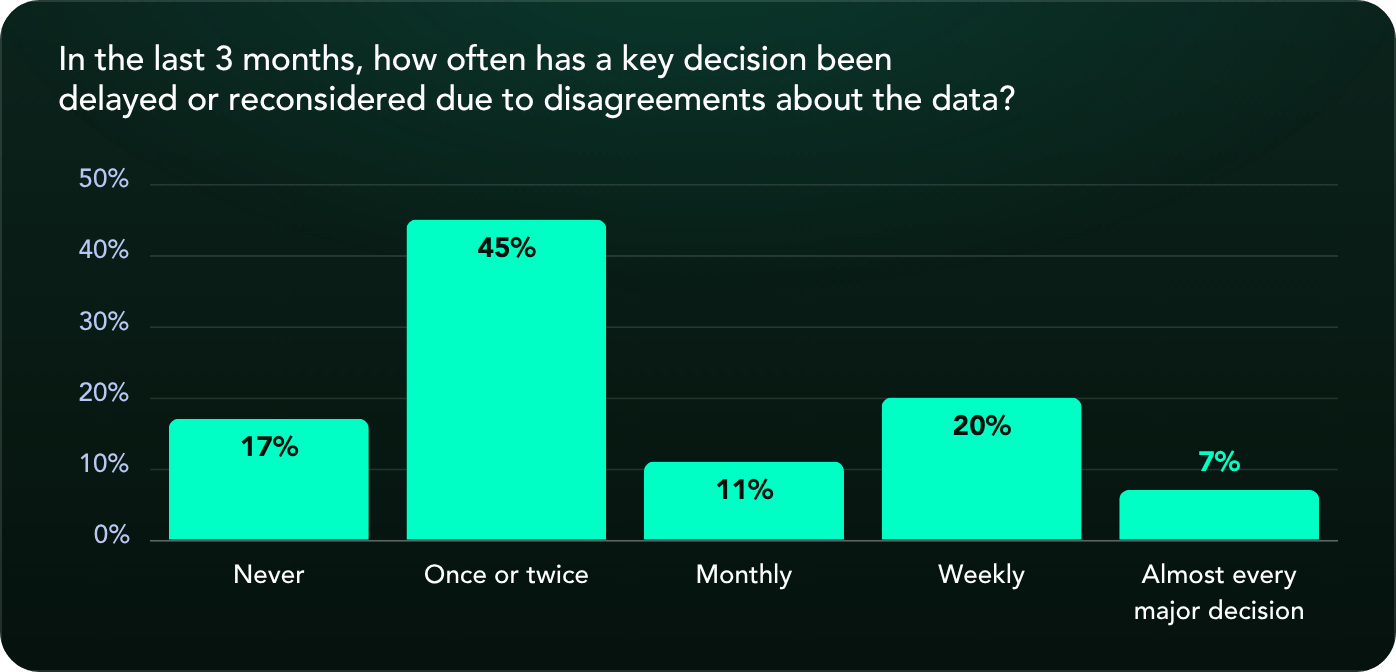
Delays in reporting inevitably translate to delays in decision-making. Before any decisions, big or small, teams often face disputes on which numbers to trust and what the data really means.
Subsequently, 83% of marketing teams have struggled with key decisions being delayed due to disagreements about the data in the last quarter alone. 20% say this happens weekly, and a further 7% say disagreements about data delay almost every major decision. While some friction is expected between teams who often have different goals to meet, this extent of disagreement around data is extreme.
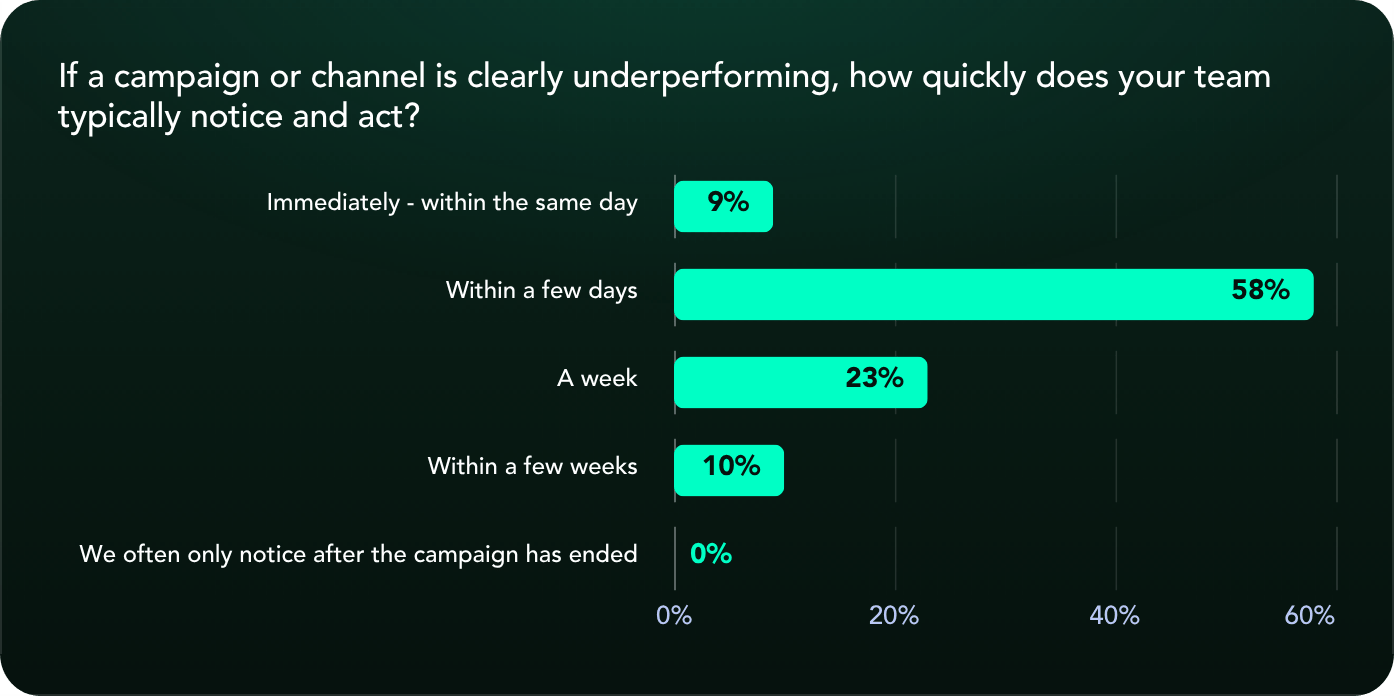
This inability to agree on what data means, and what actions should be taken is symptomatic of the lack of a shared truth and language around data. It also shines some light on why 91% of respondents say it takes days to notice and act on campaigns or channels which are clearly underperforming. For 33% of marketers it’s a matter of weeks. This should raise alarm bells - if marketers don’t even have the right support to make minor decisions like pulling a tanking creative before costs accumulate, then something is broken.
“A delay in reporting meant we noticed the drop in customer renewals too late to respond properly.”
“The majority of the advertising funding had already been spent when insights were available.”
“As a result of reporting delay, an abrupt decrease in conversion rates was considered standard and actions were taken later than they should have been.”
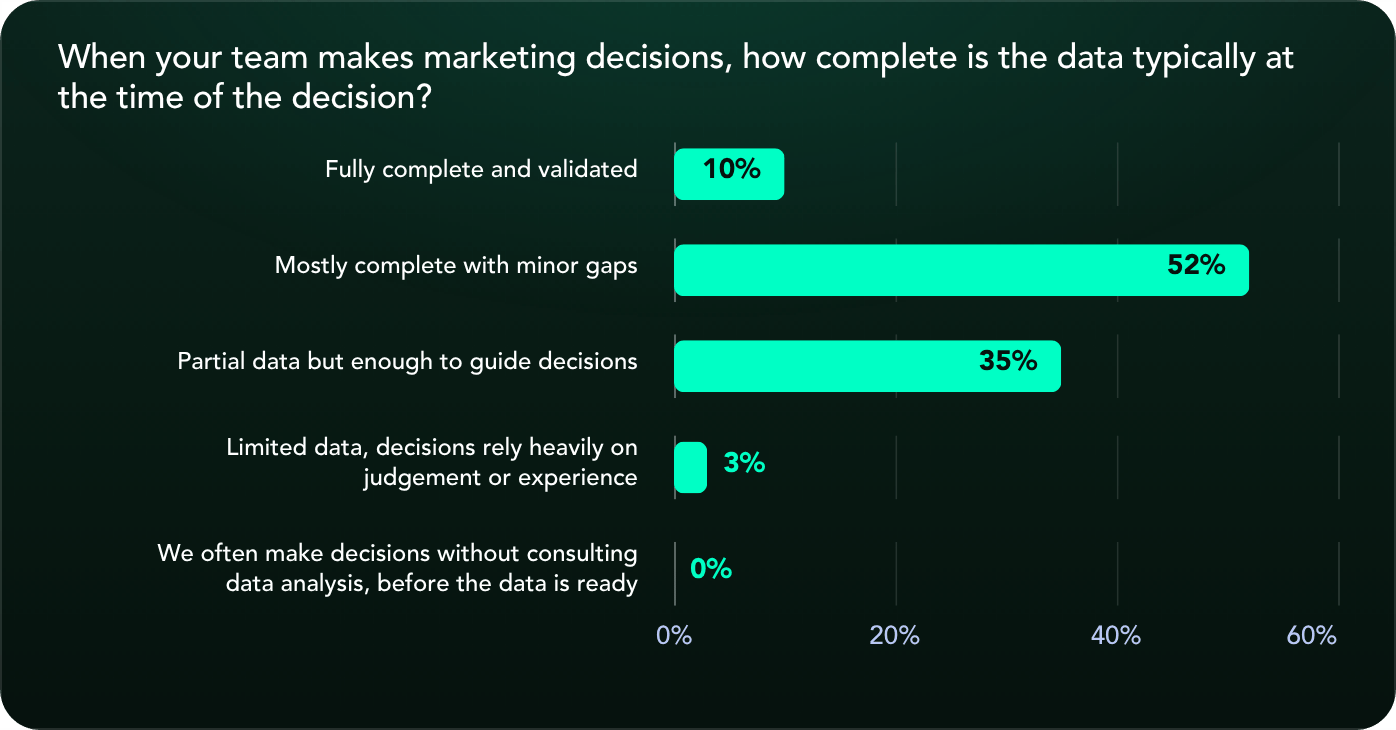
Despite spending so much of their time cleaning and validating data, only 10% of marketing teams are working with fully complete and validated data to make decisions. So, it appears most marketing analysis is at a disadvantage from the start. Completeness is a key element of data quality, and while analyzing incomplete data can give some directional truth, the risks are high. Incomplete data often distorts the picture, one pervasive example of this is that analysis of incomplete attribution tracking data will often give credit to the wrong channel.
Many respondents report incomplete data leading to wrong or delayed decisions and missed opportunities, ultimately resulting in lost budget or revenue.
“Money was moved from a profitable segment of customers due to incorrect lifetime value calculations based on retention information which was incomplete.”

“We used incomplete location data and assigned sales resources to areas with low business opportunities.”
“Incomplete data caused fraud systems to miss suspicious transactions.”
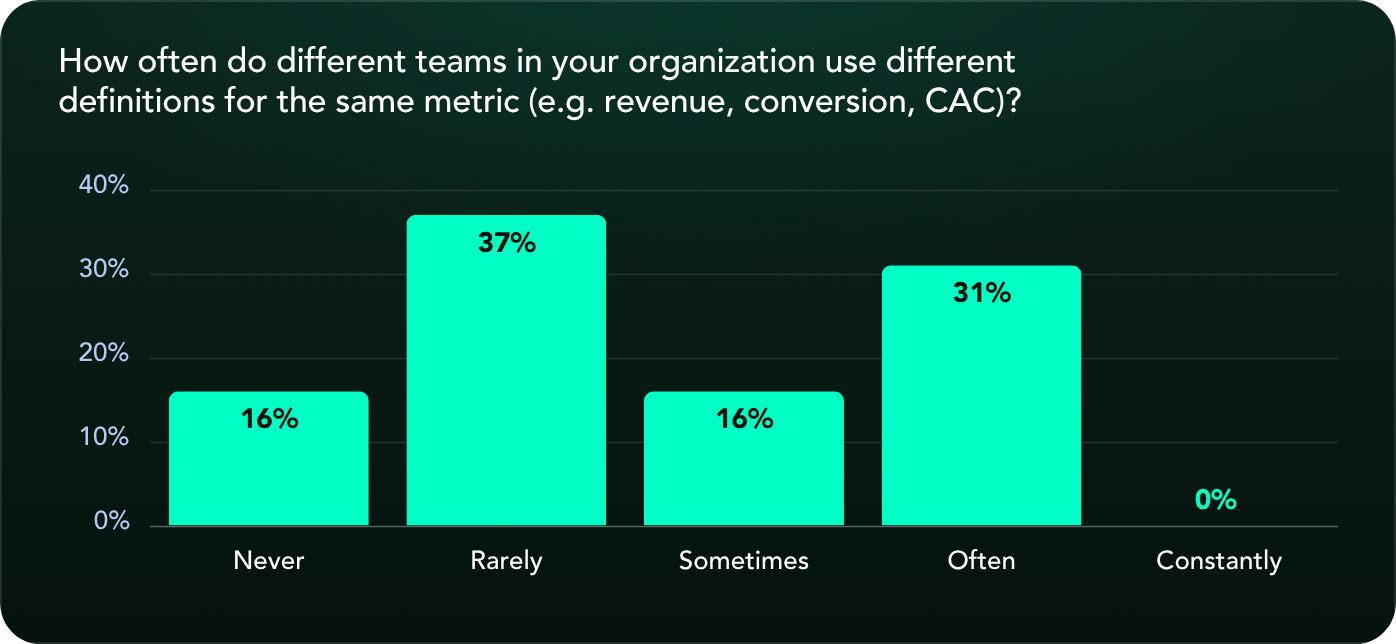
This concerning data completeness issue is underscored by another data quality issue. 84% of marketing teams are using inconsistent metric definitions, with 31% reporting that such differing metric definitions occur often.
Shared definitions are essential for humans and for analytics tools alike. Without a common understanding, nuances get lost in translation and lead to conflicting interpretations. The most time-consuming consequence of measuring key metrics inconsistently is paralysis. Mismatched numbers across departments erode trust, and decisions stall while stakeholders argue about whose numbers are correct.
When these discrepancies go unnoticed, inconsistent metrics can mean that the incorrect numbers make it through to reports and influence forecasting and decision-making. For example, one system may attribute a sale to the first touchpoint while another attributes it to the last, or one team may include agency fees in ROI calculations while another excludes them. As a result, budgets get shifted and campaigns scaled up or down according to skewed comparisons.
“Wrong tracking made one campaign look unsuccessful, so we cut spending on a channel that was actually bringing in many customers.”
“We stopped a high performing campaign because a dashboard showed incorrect ROI data, which led to lost potential revenue.”
Data quality issues are often amplified further when AI is introduced into the equation without proper context to understand or remember that data is incomplete. Without sufficient marketing knowledge, AI will often treat all data as equally valid, meaning it can’t tell the difference between a genuine zero and a missing value. And because it has the capacity to run this flawed logic faster and more often, the AI propagates the error, applying it to downstream infrastructure to deliver multiple confidently wrong answers rather than a single isolated error.
The long standing warning of “garbage in, garbage out” has taken on a new dimension in the age of AI. A more fitting variation that has emerged is “garbage in, gospel out”, which describes something even more dangerous: treating flawed, incomplete data as trustworthy simply because it has been processed by a sophisticated system.
Traditional automated reports break visibly when something is missing. AI fills the gap, makes its best guess from the information it has, and keeps going. This is what makes it so powerful, but equally if marketing teams haven’t provided rigorous context about how to handle incomplete data (ie. mapping around it or flagging it for resolution) it will produce errors. Marketing data is too complex to risk any amount of ambiguity when using AI. Any gap in context is a gap the AI will fill itself, which is how hallucinations begin to filter through.
The garbage in, gospel out problem is compounded further when tools give limited visibility into where their data insights come from, how data was transformed in transit, and what was lost or altered along the way (ie, a lack of provenance). A number that arrives in a clean dashboard looks identical whether it was correctly computed or corrupted three pipeline stages ago.
Without provenance, neither the human nor the AI can tell the difference between a trustworthy output and a corrupted one.
AI is most regularly used in data integration (26%) and for identifying patterns and anomalies in marketing data (19%). Only 8% are using it regularly to recommend campaign actions, and just 2% say AI directly acts on campaign optimizations.
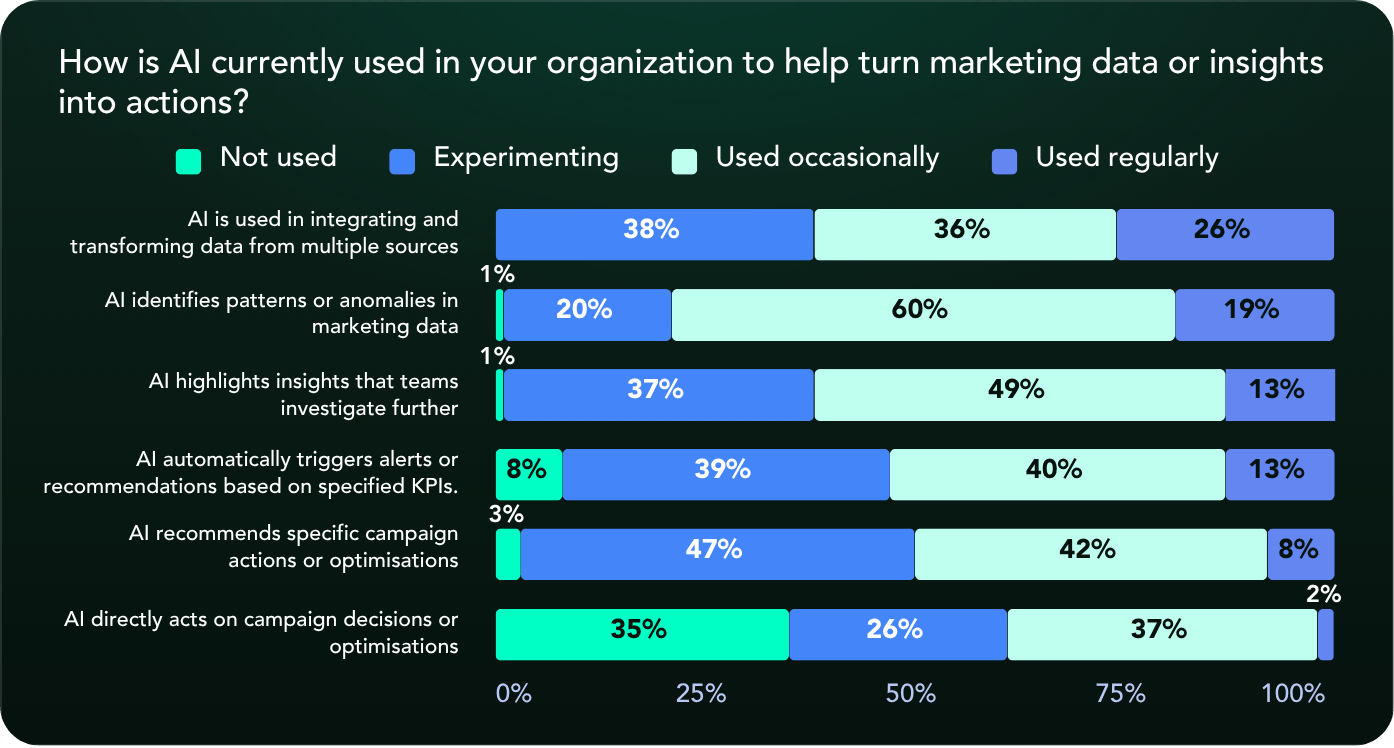
These numbers seem incredibly promising at first glance, however in tandem with the stats which uncover major issues around time-to-insights, they indicate that adoption has approached a plateau. AI tools have the capacity to speed up time to-insights. Indeed, teams using AI regularly across two or more use cases are almost 4x more likely to act on underperforming campaigns the same day. And yet the time-to-insights bottleneck persists, despite high levels of AI experimentation.
So, this brings us to perhaps the most important question of all: why are these AI experiments stalling?

Based on a survey of 300 senior marketers across the US, UK, and DACH region.